The Monday Morning Zest: 3 Quick Rituals to Start Your Week with Intention
Combatting the Sunday Scaries
Combatting the Sunday Scaries… that moment when the clock strikes 4:00pm on Sunday and you’re trying to enjoy a relaxing afternoon, but your brain suddenly switches into logistics mode, and you start mentally preparing for the Olympic sport of getting 15 toddlers into their snowsuits before someone poops in their diaper and you need to turn the bus back around.
You find yourself staring into the distance, wondering if you actually washed the paint off the brushes on Friday or if you’re about to walk into an environment with an irritated co-worker and a sink filled 'paint-brushes-turned-cement-stakes' that will require a jackhammer and a miracle to undo.
It’s a frantic internal monologue of:
I wonder if Johnny’s dirty clothes got taken home on Friday?
I wonder how many accident reports I’ll have to fill out this week?
Will everyone actually fall asleep at nap time tomorrow or will I have to put on a puppet show for 24 rambunctious preschoolers while my co-workers are on their breaks?
You try to relax, but your mind is already preemptively dodging a Lightening McQueen car while you search for Rosie’s glasses that she hid in the dramatic play fridge...again.
I know this feeling all too well because, over the past 15 years in my career, I have spent far too many sleepless Sundays lost in a mental maze of never-ending to-do lists, only to realize that while the tasks were getting done, my own sense of wonder and curiosity was being buried under the weight of it all.

The Sunday Scaries
Written By: Debra Kempf Shumaker
Illustrated By: Lavanya Naidu
But what if there was another way?
Looking back on my 15-year journey as an educator, I’ve discovered that when we trade our Sunday night bracing for a sense of intentional being, we don't just survive the week; we actually find the space to enjoy it. There can be a specific kind of magic that can happen in the quiet moments before the classroom door opens on a Monday morning if we move from surviving to thriving.
As educators, we often spend our Sundays mentally bracing for the to-do list, but what if we shifted our focus from the tasks that need to get done to the temperament we bring into the space? I’ve always believed that a passion and commitment towards early learning isn't something you're just born with; it’s a pedagogical act that can be cultivated through small, intentional habits.
Pedagogy is all about intention, and I am passionate about sharing how pedagogical acts don’t require big budgets or behaviours from others. They start from within. Making small choices each and every day moves our work from habitual and survival, to intentional and joyful.
Pedagogical acts begin with noticing and ritual. I have learned this myself as I have shifted from survivor mode many times over my career. These pedagogical choices have helped me get out of ruts, combat burnout, and find my way back to the passion that I have for this work. I am eager to help relight the fire within our sector and am sharing these ideas from my own lived experience in the field.
These three, free, and simple, soul-filling pedagogical rituals will help ground yourself back into intentional pedagogy and step into your week with the same wonder you hope to ignite in the children in your care.
The "Visual Reset" Ritual
Before the children arrive, take five minutes to walk through your space with new eyes. Instead of looking for what’s messy or missing, look for one element that makes your inspired or curious. Look for where the light hits a shelf or how a specific material feels in your hand.
The Intent: This shifts your brain from managing the environment to appreciating it. It grounds you in the physical beauty of your environment before the beautiful chaos begins.
The "First Five Minutes" Breath
Commit to making the five minutes of your day entirely "task-free." No checking cubbies, no rearranging chairs, and no looking at the clock. Spend those three minutes simply being present; perhaps while reading a few intention cards or while a favorite song plays softly in the background.
The Intent: This creates a mental buffer between your commute and your role. It signals to your nervous system that you are the captain of your calm, not a servant to the schedule.
The "Curious Anchor" Intention
Write down one thing you are genuinely curious to observe today. It could be as simple as, "I wonder how Leo will interact with the new silk scarves," or "I’m curious to see how the light changes in the block corner this afternoon."
The Intent: By choosing one specific thing to be curious about, you give your brain a positive hook to hang onto. It transforms the day from a list of to-do’s into a live research project that you are excited to be a part of.
The Pedagogical "Why"
The shift from task-management to temperament-building isn't just a wellness trend; it is deeply rooted in the pedagogical concept of the Pedagogy of Listening (Rinaldi, 2006) and the Theory of Self-Determination (Deci & Ryan, 2000). Research consistently shows that an educator’s emotional regulation and presence serve as the invisible scaffolding for a child’s learning environment.
As Dr. Jean Clinton reminds us, “You are responsible for the energy you bring into your classroom.” And this isn’t easy! Between CWELCC changes, the growing list of administrative tasks, family expectations, and that not so easy co-worker; we all have valid reasons to not see the light at the end of the tunnel. I am encouraging you to use pedagogy as your light. Infusing intention into small daily acts not only improves the lives around you, it also improves yours.
When we operate from a state of chronic state of fight or flight, we trigger our own sympathetic nervous system, which inadvertently ripples through the classroom, often leading to increased dysregulation (and all those not so fun behaviours we manage) in the children in our care.
When I think about this from a leadership perspective, cultivating this pedagogical awareness is the literal heartbeat of recruitment and retention. High-quality Early Childhood Education is a marathon of emotional labor; when we fail to prioritize the intellectual and emotional fulfillment of the educator, we see the burnout that leads to high turnover. And don’t just take my word for it, there is scary and sad data to back this up. See this stark image below from Knowing Our Numbers Report (2024).
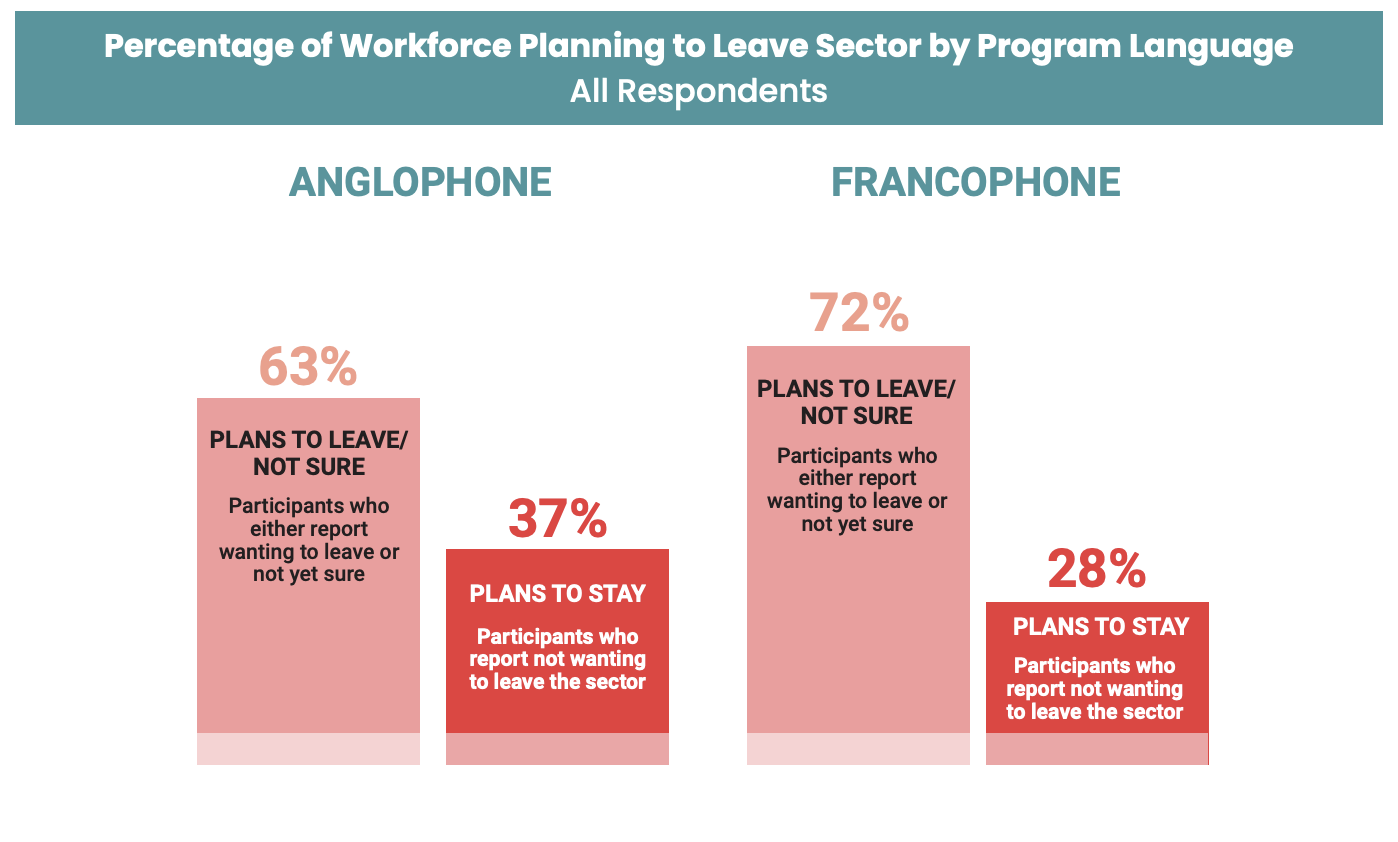
Akbari, E., McCuaig, K., Schurter, M. Varmuza, P., Akbari, S., Mudie, S. Knowing Our Numbers (2024).
The data is clear, but the reality is even more staggering: nearly two-thirds of our workforce are either unsure or planning their exit from the sector. When we lose 63–72% of our educators, we aren't just losing staff; we are losing the collective wisdom, high-quality learning environments, mentorship, the stable relationships, and the consistency that our children and families rely on for a sense of security. I have been a fierce advocate for many years that retention starts with reclaiming our professional joy. We cannot sustain a high-quality sector if we do not sustain the humans who power it.
By fostering a collective of educators that values curiosity and intentionality over mere compliance, we transform the role of an ECE from a supervisory technician into a dynamic, fulfilling career. When educators feel like co-researchers who are supported in their own wonder, they don't just stay in the field, they thrive. In turn, they create a stable, high-quality early learning sector that benefits children, families, and the profession at large.
In the end, the children in our care don't need a perfect educator; they need a present one. When we choose to nourish our own passion and joy, we give others around us permission to do the same. I hope you give yourself that permission this week.
Stay Curious,
Jessica Karpathios
Founder, The Curious Educator Collective
References
Rinaldi, C. (2006). In dialogue with Reggio Emilia: Listening, researching and learning. Routledge.
Ryan, R. M., & Deci, E. L. (2000). Self-determination theory and the facilitation of intrinsic motivation, social development, and well-being. American Psychologist, 55(1), 68–78. https://doi.org/10.1037/0003-066X.55.1.68
Akbari, E., McCuaig, K., Schurter, M. Varmuza, P., Akbari, S., Mudie, S. (2024). Knowing Our Numbers: A Provincial Study with a Local Lens on the Early Childhood Education Workforce in Ontario.